


Request callback

Say Hi! on Whatsapp


Financial Risk Manager (FRM®) Certification
Master Financial Risk Management with Global FRM Certification




Duration
8-10 months study period

Avg. Salary**
INR 11 LPA

Scope
Career opportunities in India & Abroad
Duration
8-10 months study period
Avg. Salary**
INR 11 LPA
Scope
Career opportunities in India & Abroad




Imarticus Learning and KPMG in India collaborate together to create industry-led prep programs with real-world case studies, curated resources, internship, and a joint certification — bridging academics with practical expertise for career success.
Joint Certification:
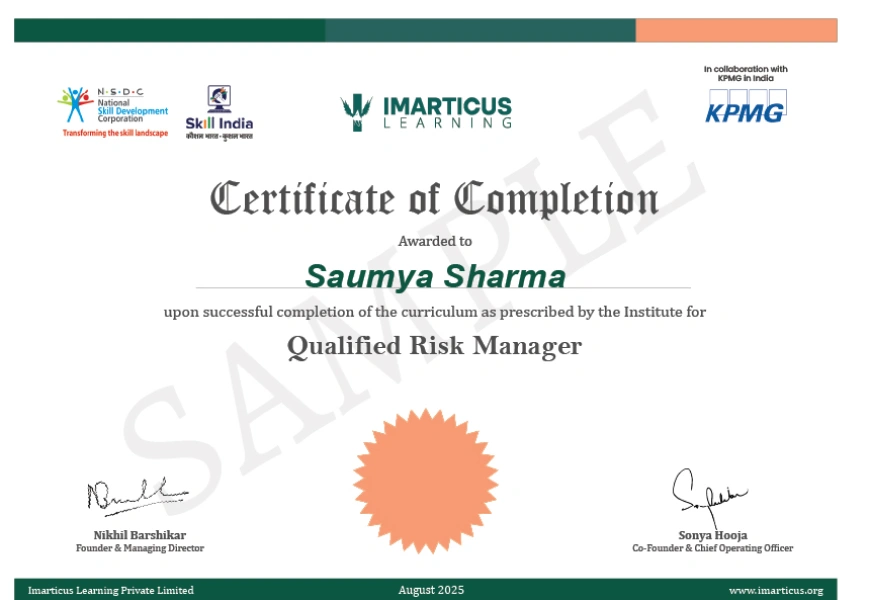
Showcase your expertise with a joint certification upon completing the program, giving your resume a competitive edge.
Tailored Learning Materials:
Access exclusive resources specifically designed for FRM, CFA, US CMA, US CPA and ACCA aspirants.
Webinars and Live Sessions
Monthly webinars on current trends and industry insights. One hour live sessions conducted by KPMG in India practitioners (12 sessions annually).

Joint Certification:
Showcase your expertise with a joint certification upon completing the program, giving your resume a competitive edge.
Tailored Learning Materials:
Access exclusive resources specifically designed for FRM, CFA, US CMA, US CPA and ACCA aspirants.
Webinars and Live Sessions
Monthly webinars on current trends and industry insights. One hour live sessions conducted by KPMG in India practitioners (12 sessions annually).
Build Real-World Skills:
Solve 23 business case studies from top 5 global finance courses, aligned with your sessions and evaluated by KPMG in India practitioners.

Internships for Top Performers:
Stand out with a unique opportunity to intern at KPMG in India, gaining hands-on experience and exposure to global industry practices.
Eligibility:
Open to the top performer who excels in internal assessments and pass the certification exam.

Your journey to becoming a global financial expert starts here.
Join Our Program

What makes Imarticus Learning your perfect learning partner for FRM

Imarticus Learning ∞ KPMG in India
Industry -led FRM prep program featuring real-world case studies, curated resources, and a joint certification with KPMG in India.

India’s First & Only
We are India's First & Only Approved Prep Provider for the World's Top 5 Certifications in Accounting & Finance - FRM, CFA, ACCA, US CPA & US CMA.

GARP-Approved Prep Provider
Imarticus Learning is a GARP-Approved Prep Provider —offering globally recognized FRM® training backed by expert faculty, structured guidance, and trusted study resources to help you succeed.
Study Resources from Analyst Prep
Prepare with Analyst Prep FRM®, a trusted GARP-approved content provider for the FRM Exam. Get exclusive access to Analyst Prep’s complete FRM study tools, including question banks, practice exams, and guided learning resources.

Money-Back Guarantee
When you study for FRM course in Imarticus, you have a 100% guarantee to pass and if you fail to do so we refund 50% of your course fee.

Pre-placement Bootcamp
Exclusive one-to-one mentoring sessions focussed on soft skills development and comprehensive interview preparation.
Get Started


Our Alumni work at









Curriculum
The FRM® curriculum is divided into two levels: Part 1 covers four subjects focused on quantitative methods, financial fundamentals, and market understanding, while Part 2 includes six subjects that delve deeper into investment management and advanced risk management.

FRM Part I
FRM Part II
Foundations of Risk Management | 20%
This area focuses on foundational concepts of risk management and how risk management can add value to an organization. The broad knowledge points covered in Foundations of Risk Management include the following:
Topics covered

Basic risk types, measurement, and management tools
Creating value with risk management
Risk governance and corporate governance
Credit risk transfer mechanisms
The Capital Asset Pricing Model (CAPM)
Risk-adjusted performance measurement
Multifactor models
Data aggregation and risk reporting
Financial disasters and risk management failures
Ethics and the GARP Code of Conduct
Enterprise risk management (ERM)
Quantitative Analysis | 20%
This area focuses on basic probability and statistics, regression and time series analysis, and various quantitative techniques useful in risk management. The broad knowledge points covered in Quantitative Analysis include the following:
Topics covered
Discrete and continuous probability distributions
Estimating the parameters of distributions
Population and sample statistics
Bayesian analysis
Statistical inference and hypothesis testing
Measures of correlation
Linear regression with single and multiple regressors
Time series analysis and forecasting
Simulation methods
Machine learning
Financial Markets and Products | 30%
This area focuses on financial products and the markets in which they trade, more specifically, the following knowledge areas:
Topics covered
Structures and functions of financial institutions
Structure and mechanics of over-the-counter (OTC) and exchange markets
Structure, mechanics, and valuation of forwards, futures, swaps, and options
Hedging with derivatives
Interest rates and measures of interest rate sensitivity
Foreign exchange risk
Corporate bonds
Mortgage-backed securities
Valuation and Risk Models | 30%
This area focuses on valuation techniques and risk models. The broad knowledge points covered in Valuation and Risk Models include the following:
Topics covered
Value-at-Risk (VaR)
Expected shortfall (ES)
Estimating volatility and correlation
Economic and regulatory capital
Stress testing and scenario analysis
Option valuation
Fixed-income valuation
Hedging
Country and sovereign risk models and management
External and internal credit ratings
Expected and unexpected losses
Operational risk
Foundations of Risk Management | 20%
This area focuses on foundational concepts of risk management and how risk management can add value to an organization. The broad knowledge points covered in Foundations of Risk Management include the following:
Topics covered
Basic risk types, measurement, and management tools
Creating value with risk management
Risk governance and corporate governance
Credit risk transfer mechanisms
The Capital Asset Pricing Model (CAPM)
Risk-adjusted performance measurement
Multifactor models
Data aggregation and risk reporting
Financial disasters and risk management failures
Ethics and the GARP Code of Conduct
Enterprise risk management (ERM)
Quantitative Analysis | 20%
This area focuses on basic probability and statistics, regression and time series analysis, and various quantitative techniques useful in risk management. The broad knowledge points covered in Quantitative Analysis include the following:
Topics covered
Discrete and continuous probability distributions
Estimating the parameters of distributions
Population and sample statistics
Bayesian analysis
Statistical inference and hypothesis testing
Measures of correlation
Linear regression with single and multiple regressors
Time series analysis and forecasting
Simulation methods
Machine learning
Financial Markets and Products | 30%
This area focuses on financial products and the markets in which they trade, more specifically, the following knowledge areas:
Topics covered
Structures and functions of financial institutions
Structure and mechanics of over-the-counter (OTC) and exchange markets
Structure, mechanics, and valuation of forwards, futures, swaps, and options
Hedging with derivatives
Interest rates and measures of interest rate sensitivity
Foreign exchange risk
Corporate bonds
Mortgage-backed securities
Valuation and Risk Models | 30%
This area focuses on valuation techniques and risk models. The broad knowledge points covered in Valuation and Risk Models include the following:
Topics covered
Value-at-Risk (VaR)
Expected shortfall (ES)
Estimating volatility and correlation
Economic and regulatory capital
Stress testing and scenario analysis
Option valuation
Fixed-income valuation
Hedging
Country and sovereign risk models and management
External and internal credit ratings
Expected and unexpected losses
Operational risk
Foundations of Risk Management | 20%
This area focuses on foundational concepts of risk management and how risk management can add value to an organization. The broad knowledge points covered in Foundations of Risk Management include the following:
Topics covered
Basic risk types, measurement, and management tools
Creating value with risk management
Risk governance and corporate governance
Credit risk transfer mechanisms
The Capital Asset Pricing Model (CAPM)
Risk-adjusted performance measurement
Multifactor models
Data aggregation and risk reporting
Financial disasters and risk management failures
Ethics and the GARP Code of Conduct
Enterprise risk management (ERM)
Quantitative Analysis | 20%
This area focuses on basic probability and statistics, regression and time series analysis, and various quantitative techniques useful in risk management. The broad knowledge points covered in Quantitative Analysis include the following:
Topics covered
Discrete and continuous probability distributions
Estimating the parameters of distributions
Population and sample statistics
Bayesian analysis
Statistical inference and hypothesis testing
Measures of correlation
Linear regression with single and multiple regressors
Time series analysis and forecasting
Simulation methods
Machine learning
Financial Markets and Products | 30%
This area focuses on financial products and the markets in which they trade, more specifically, the following knowledge areas:
Topics covered
Structures and functions of financial institutions
Structure and mechanics of over-the-counter (OTC) and exchange markets
Structure, mechanics, and valuation of forwards, futures, swaps, and options
Hedging with derivatives
Interest rates and measures of interest rate sensitivity
Foreign exchange risk
Corporate bonds
Mortgage-backed securities
Valuation and Risk Models | 30%
This area focuses on valuation techniques and risk models. The broad knowledge points covered in Valuation and Risk Models include the following:
Topics covered
Value-at-Risk (VaR)
Expected shortfall (ES)
Estimating volatility and correlation
Economic and regulatory capital
Stress testing and scenario analysis
Option valuation
Fixed-income valuation
Hedging
Country and sovereign risk models and management
External and internal credit ratings
Expected and unexpected losses
Operational risk
Market Risk Measurement and Management | 20%
This area focuses on market risk measurement and management techniques. The broad knowledge points covered in Market Risk Measurement and Management include the following:
Topics covered
VaR and other risk measures
Parametric and non-parametric methods of estimation
VaR mapping
Backtesting VaR
Expected shortfall (ES) and other coherent risk measures
Extreme Value Theory (EVT)
Modeling dependence: correlations and copulas
Term structure models of interest rates
Volatility: smiles and term structures
Fundamental Review of the Trading Book (FRTB)
Credit Risk Measurement and Management | 20%
This area focuses on a candidate’s understanding of credit risk management, with some focus given to structured finance and credit products such as collateralized debt obligations and credit derivatives. The broad areas of knowledge covered in readings related to Credit Risk Measurement and Management include the following:
Topics covered
Credit analysis
Default risk: quantitative methodologies
Expected and unexpected loss
Credit VaR
Counterparty risk
Credit derivatives
Structured finance and securitization
Operational Risk and Resilience | 20%
This area focuses on methods to measure and manage operational risk as well as methods to manage risk across an organization, including risk governance, stress testing, and regulatory compliance. The broad knowledge points covered in Operational Risk and Resilience include the following:
Topics covered
Governance of operational risk management frameworks
Identification, classification, and reporting of operational risks
Measurement and assessment of operational risks
Mitigation of operational risks
Cyber-resilience and operational resilience
Risks related to money laundering, financing of terrorism, financial crime, and fraud
Third-party outsourcing risk
Model risk and model validation
Stress testing banks
Risk-adjusted return on capital (RAROC)
Economic capital frameworks and capital planning
Regulation and the Basel Accords
Liquidity and Treasury Risk Measurement and Management | 15%
This area focuses on methods to measure and manage liquidity and treasury risk. The broad knowledge points covered in the Liquidity and Treasury Risk Management section include the following:
Topics covered
Liquidity risk principles and metrics
Managing liquidity needs and monitoring liquidity positions
Cash-flow modeling, liquidity stress testing, and reporting
Contingency funding plan
Funding models
Funds transfer pricing
Cross-currency funding
Balance sheet management
Asset liquidity
Risk Management and Investment Management | 15%
This area focuses on risk management techniques applied to the investment management process. The broad knowledge points covered in Risk Management and Investment Management include the following:
Topics covered
Factor theory
Portfolio construction
Portfolio risk measures
Risk budgeting
Risk monitoring and performance measurement
Portfolio-based performance analysis
Hedge funds
Current Issues in Financial Markets | 10%
This area focuses on current issues that have a strong impact on financial markets. The broad knowledge points covered in Current Issues in Financial Markets include the following:
Topics covered
2023 bank failures
Artificial intelligence
Interest rate and inflation risk
Private credit
Risks of rising government debt
Cryptocurrency regulation
Digital resilience
Download Curriculum




Become an FRM-certified professional and land top finance roles in India and abroad

Quantitative Analyst
The Quantitative Analyst develops complex models and algorithms to analyse financial data and predict market trends. This role involves leveraging mathematical and statistical techniques to improve investment strategies, risk management, and trading decisions.
₹20.7 LPA
**Average Salary in India
$101,000
**Average Salary in Abroad
Financial Analyst
The Financial Analyst evaluates financial data, forecasts performance, and assesses risks to guide business and investment decisions. They provide insights through financial models and reports that support resource allocation and growth strategies.
₹15.4 LPA
**Average Salary in India
$64,000
**Average Salary in Abroad
Equity Research Analyst
The Equity Research Analyst specialises in analysing stocks and providing insights on equity investments. This role involves assessing financial reports, market trends, and company performance to generate investment recommendations for institutional and individual investors.
₹10.9 LPA
**Average Salary in India
$101,000
**Average Salary in Abroad
Risk Analyst
The Risk Analyst assesses financial and operational risks that may impact an organisation's performance. This role involves evaluating risk factors, performing scenario analysis, and recommending strategies to mitigate risks and enhance financial stability.
₹7.9 LPA
**Average Salary in India
$71,000
**Average Salary in Abroad
Credit Risk Analyst
The Credit Research Analyst evaluates the creditworthiness of companies or entities by analysing financial statements, economic data, and market trends. This role involves assessing risks, making recommendations, and presenting findings to support lending and investment decisions.
₹9.1 LPA
**Average Salary in India
$69,000
**Average Salary in Abroad
Investment Analyst
The Investment Analyst conducts in-depth research on markets, industries, and companies to identify potential investment opportunities. This role involves analysing financial data, preparing reports, and providing recommendations to portfolio managers and investors.
₹12 LPA
**Average Salary in India
$70,000
**Average Salary in Abroad
Quantitative Analyst
The Quantitative Analyst develops complex models and algorithms to analyse financial data and predict market trends. This role involves leveraging mathematical and statistical techniques to improve investment strategies, risk management, and trading decisions.
₹20.7 LPA
**Average Salary in India
$101,000
**Average Salary in Abroad
Financial Analyst
The Financial Analyst evaluates financial data, forecasts performance, and assesses risks to guide business and investment decisions. They provide insights through financial models and reports that support resource allocation and growth strategies.
₹15.4 LPA
**Average Salary in India
$64,000
**Average Salary in Abroad
Equity Research Analyst
The Equity Research Analyst specialises in analysing stocks and providing insights on equity investments. This role involves assessing financial reports, market trends, and company performance to generate investment recommendations for institutional and individual investors.
₹10.9 LPA
**Average Salary in India
$101,000
**Average Salary in Abroad
Risk Analyst
The Risk Analyst assesses financial and operational risks that may impact an organisation's performance. This role involves evaluating risk factors, performing scenario analysis, and recommending strategies to mitigate risks and enhance financial stability.
₹7.9 LPA
**Average Salary in India
$71,000
**Average Salary in Abroad
Credit Risk Analyst
The Credit Research Analyst evaluates the creditworthiness of companies or entities by analysing financial statements, economic data, and market trends. This role involves assessing risks, making recommendations, and presenting findings to support lending and investment decisions.
₹9.1 LPA
**Average Salary in India
$69,000
**Average Salary in Abroad
Investment Analyst
The Investment Analyst conducts in-depth research on markets, industries, and companies to identify potential investment opportunities. This role involves analysing financial data, preparing reports, and providing recommendations to portfolio managers and investors.
₹12 LPA
**Average Salary in India
$70,000
**Average Salary in Abroad
Enrol Now
Your roadmap to FRM success

1
Enrol in the FRM Course
Kickstart your FRM journey with expert-led classes and structured exam preparation support.

2
Access Official FRM Study Resources
Get complete FRM study resources through Analyst Prep, including practice questions and comprehensive study content to build confidence and mastery.

3
Begin with the Pre-course
Build base knowledge with pre-learning modules designed to ease you into core FRM topics.

4
Learn FRM Part I Modules
Cover foundational areas like risk basics, valuation models, and financial market principles.

5
Advance to Part II Topics
Gain expertise in market, credit, operational, and investment risk management practices.

6
Pass the FRM Exam
Clear both levels of the FRM exam - the primary requirement to move toward FRM certification.

7
Gain Work Experience
Complete two years of full-time experience in risk, finance, or related professional roles.

8
Apply for the FRM Charter
Submit your work credentials and membership application to GARP for official charter approval.

9
Earn the FRM Designation
Receive the globally respected FRM title and fast-track your career in risk and finance.
Start Your Journey Now!



Learn from industry-leading FRM practitioners and industry veterans

Amit Parakh
Lead Trainer - FRM, CFA
Amit Parakh is a seasoned finance educator with extensive experience in banking and equity research. Formerly with ICICI Bank and JP Morgan, he specializes in valuation, risk management, and financial analysis. He conducts FRM, CFA, CA, and MBA programs, offering deep industry insights through expert-led workshops and training sessions.

Shivram Das
Finance Educator & Mentor
With 17+ years of experience in investment banking, finance, accounts, audit, and taxation, Shivram Das is a dynamic professional and skilled trainer. He specializes in BFSI content development, financial modeling, GST training, and curriculum design, with expertise in financial reporting, working capital management, and internal financial controls.

Prof. Vinit Mehta
Lead Faculty - CFA, Founder- The Capstone Learnings
With 12+ years in finance and 5+ years as an educator, Prof. Vinit Mehta brings expertise in investment, corporate, and international banking. Having worked across Europe, Asia, the Middle East, and Africa, he offers a holistic financial perspective, blending global insights with Indian market expertise to deliver impactful, real-world learning.

Nilay Arun
FRM Trainer, Founder- Alaavo
Nilay Arun is an experienced professional in start-up consulting, market entry advisory, and venture building. He has led analytics and risk teams, corporate financial training, and client relationships across Asia, Europe, and the US. Passionate about technology, education, finance, endurance sports, and community building, he brings a dynamic, multidisciplinary approach.

Anand Jhanwar
Finance Consultant and Trainer
Anand Jhanwar, a CFA Charterholder, FRM, and MBA (Finance), brings 19+ years of industry experience as a freelance analyst, consultant, and trainer. He has delivered 1,500+ programs across UAE, Africa, Vietnam, Qatar, and India, specialising in financial modelling, valuation, M&A analysis, investment research, and corporate training.

Sonia Varshneya
Associate director, CFO Advisory at KPMG in India
Sonia is an Associate Director with the CFO Advisory practice at KPMG in India, bringing over 13 years of experience in statutory audits, financial reporting, and accounting advisory. She has led multiple IFRS/Ind AS implementation and convergence projects across industries and advised clients on complex technical accounting matters. Sonia has also conducted professional training sessions in India and South Africa, and has taught at leading universities through both online and in-person formats.

Sakshi Gour
Associate Director, CFO Advisory at KPMG in India
Sakshi is an Associate Director with CFO Advisory at KPMG in India, specializing in accounting solutions for the renewable energy sector. With 11+ years of experience in financial reporting, audits, and IFRS/Ind AS advisory across industries, she’s known for her hands-on client approach and problem-solving skills. Sakshi also leads corporate and university training programs, including a Ministry of Home Affairs initiative for students in Jammu & Kashmir.
Enquire Now



FRM exam structure


*Note: For the latest update on exam fee check the GARP website.
Enrol Now
Key skills mastery after completing FRM

Financial Accounting
Financial Reporting
Financial Analysis
Tax Planning
GAAP and IFRS Expertise
Financial Reporting and Analysis
Taxation and Compliance
Auditing, Attestation and Assurance
Cost and Managerial Accounting
Business Regulations
Ethical Judgment and Professionalism
Regulatory Compliance
Risk Management
Corporate Governance
Business Valuation
Accounting Software Proficiency
Data Analytics and AI in Accounting
Cybersecurity and IT Controls
Critical Thinking and Problem-Solving
Communication and Presentation Skills
Time Management and Organisation
Industry-aligned FRM preparation program in collaboration with KPMG in India




FRM Certification: Financial Risk Manager Course
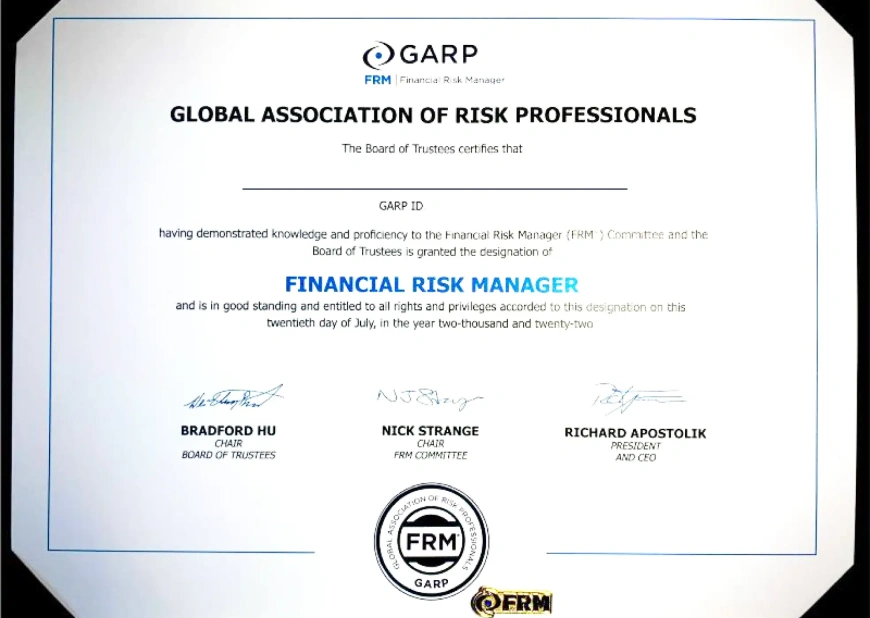
Joint Certification
Program Fee


Enroll Now
Frequently asked questions
The Financial Risk Manager (FRM) certification, awarded by GARP, is the global standard for risk management professionals. It validates expertise in market risk, credit risk, operational risk, and investment risk management.
The FRM focuses on risk management, covering topics such as valuation, risk models, and integrated risk management. The CFA provides a broader finance perspective but does not delve as deeply into risk. Many professionals pursue both certifications for a competitive edge in finance.
The FRM certification is globally recognised, with 90,000+ certified professionals working at leading banks, asset managers, hedge funds, consultancies, and regulatory bodies. It enhances career opportunities in risk management and finance.
No, membership is not required to register for the exam. However, enrolling in the FRM Program includes a one-year Individual Membership, which can be renewed. Certified professionals receive a discounted membership rate.
No, but GARP recommends CPD participation to maintain the value of certification. The program requires earning 40 credits every two years, with one credit per hour of relevant learning.
There are no eligibility requirements for this exam; even individuals who have just completed their 12th grade can take it.
The KPMG name and logo are trademarks used under license by the independent member firms of the KPMG global organization. The KPMG trademarks are the sole property of KPMG International Cooperative.
KPMG in India is not involved in the placement assistance or internship offered through this program and does not guarantee employment, career advancement, or future earnings. Its role is limited to providing FRM preparation and training for a specified number of hours, without endorsing or committing to any salary expectations. However the top performing participant will gain access to a KPMG in India internship opportunity while the next four highest achievers will be invited to engage in webinars and virtual events exploring global accounting practices as part of the FRM program. This is in addition to the original case studies as part of the overall program experience.
Yes, KPMG in India will create and share a total of 23 original case studies aligned with various professional programs. These case studies are designed to offer real-world insights and practical application across different domains.
The breakdown is as follows:
- FRM (USA): 2 case studies
- ACCA Skill: 5 case studies
- ACCA Professional: 3 case studies
- CMA (US GAAP): 7 case studies
- CPA (US GAAP): 4 case studies
- CFA (USA): 2 case studies
Only the top performer in the FRM program will be eligible for an internship at KPMG in India. The internship will be offered to select learner/s based on specific eligibility criteria.
The final selection is at the mutual discretion of Imarticus Learning and KPMG in India. Neither Imarticus Learning nor KPMG in India takes any responsibility for your placement in a full-time role or for the conversion of the internship into a Pre-Placement Offer (PPO) upon completion of the program.
FRM salary in Big 4 firms range from Rs. 6-11 LPA** in India and may vary based on multiple factors like experience, location, industry and one’s professional competence.
**All salary-related data presented has been sourced from credible job and employer review platforms, including Indeed. Average salary in Abroad is calculated as the average salary in the US, UK and Canada.
Follow us on


Download our app


Download our app